
Buying · 8 min read
Act 14, 15 and 16: how an off-plan purchase works, stage by stage, on a real project
What the three construction acts mean, how the contract work runs from the deposit to the notary, and when you actually become the owner. Explained on J'Adore Blanc in Sunny Beach.
17 November 2026Collins Solicitors legal team
Anyone buying off-plan in Bulgaria soon hears about “Act 14”, “Act 15” and “Act 16”. They sound like bureaucracy, but they are the milestones that tell you how far the building has come, when you pay and when you can expect the notary. Below we explain each one, and also how the contract side works, from the first deposit to the deed.
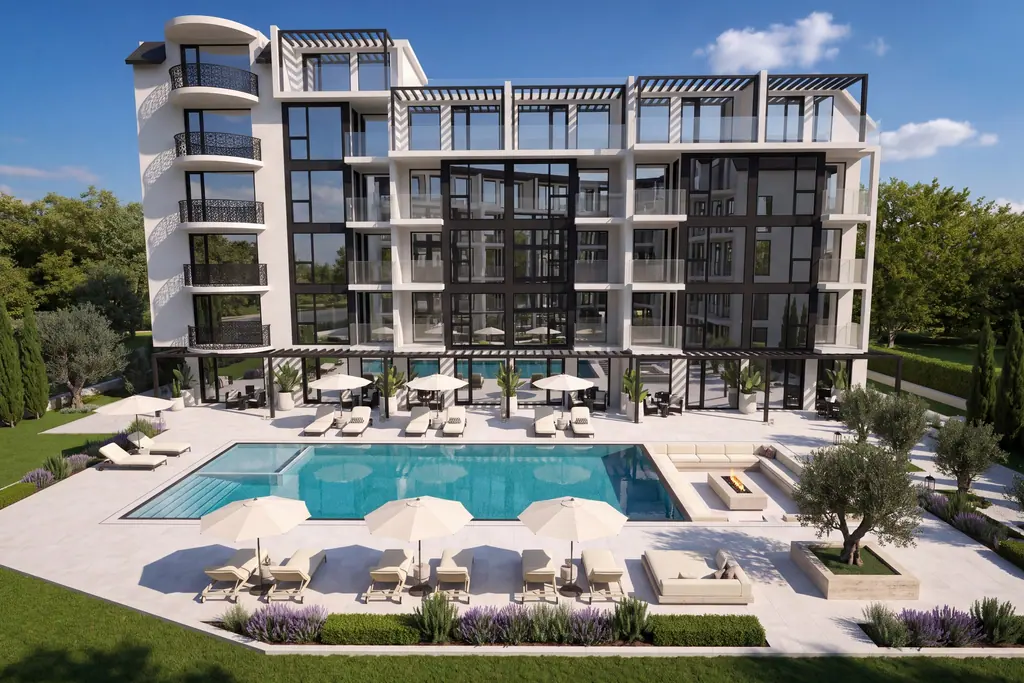
Collins Solicitors works with Virgin Build, the developer of the J'Adore projects in Sunny Beach, so we use its current project, J'Adore Blanc, as the example. We say so openly so that you can weigh our view accordingly. The legal points apply to any new building on the coast.
 Pool at dusk
 The buildings at night
 Reception
 Living room
 Lobby
 Bedroom
Where it starts: the deposit and an individual payment plan
Once you have chosen an apartment, the price and the payment plan are agreed with you individually. Typically a deposit takes the apartment off the market, a first instalment follows shortly after the preliminary contract is signed (on current Blanc contracts this is about 40%), and the rest is spread over the construction period with fixed dates. The schedule is written into the contract, so you know every amount and every date in advance.
The deposit is not just a down payment. Under Art. 93 of the Obligations and Contracts Act it secures the contract in both directions: if the buyer walks away, the seller may keep it; if the seller fails to perform, the buyer may withdraw and claim it back twice over.
The preliminary contract: what it fixes
The preliminary contract is the main document of an off-plan purchase. The law requires it to be in writing and to contain the essential terms of the future deed (Art. 19(1)–(2) ЗЗД). If either side later refuses to sign the deed, the other can ask the court to declare the preliminary contract final, and the court’s decision then works as the deed (Art. 19(3)).
On Blanc the contract is drawn up in Bulgarian and in the buyer’s language side by side. These are the clauses we consider most important for the buyer:
- The exact apartment: number, floor, area, share of the common parts and the cadastral identifier of the plot, so there is no doubt about what is being sold.
- The finish level, written out: brick walls, full thermal insulation, PVC windows, laminate floors, a tiled bathroom with fittings and water heater, granite tiles on the terraces, entrance and interior doors.
- Deadlines: Act 15 within 36 months of the site being opened, and the application for commissioning within 10 months after Act 15.
- Progress reports during construction, with photos or video on request.
- The seller declares that the apartment is free of encumbrances. If any exist on the day of the deed, the buyer may terminate the contract and recover everything paid plus a penalty of 10% of the price.
- Ownership is transferred at the notary once the price is paid in full, and the buyer can go to court under Art. 19(3) if the seller refuses.
- Visible defects found at handover are repaired at the seller’s cost within 30 working days; hidden defects are covered by the statutory guarantee periods, which run from the use permit.
- Even in the extreme scenario the contract provides for (construction costs up more than 20% in a year or inflation above 10%), every euro the buyer has paid is returned within 30 working days if the contract ends.
A fair contract binds both sides. The buyer’s main duty is to pay on time: a delay of more than 14 days carries a daily penalty, and a delay of more than 30 days allows the seller to terminate after a written warning. We go through these clauses with every client before anything is signed.
Act 14: the structure is complete
The construction acts are standard forms under Ordinance No. 3 of 2003 on acts and protocols during construction. Act 14 (form 14) is the protocol accepting the load-bearing structure: the designers, the builder and the construction supervisor confirm that the frame has been built according to the approved design. In practice this is the “rough construction” stage: concrete frame, slabs and roof, no finishing yet.
Act 14 is a technical milestone, not a sales document. It shows that the building exists physically and that the structure was checked. Many payment plans have an instalment around this stage.
Act 15: the building is finished
Act 15 (form 15) is the statement that the building is fit to be accepted. The builder hands the finished building and its documentation over to the investor, and the participants record that the works match the design. Act 15 does not yet allow the building to be used, but for the buyer it is the key moment.
Under the Blanc contract, the developer must notify the buyer by email within three weeks of Act 15 and invite them to the notary. The deed is then signed within the agreed term, usually three or four months, provided the price has been paid in full.
Act 16: permission to use
The last step is commissioning. For larger buildings (categories I to III) a state acceptance committee draws up the protocol in form 16, and the Directorate for National Construction Control (DNSK) issues a use permit. For smaller buildings (categories IV and V) the authority that issued the building permit issues a certificate of commissioning (Art. 177 ЗУТ). In everyday language both are called “Act 16”.
From this date the building is formally in use, and the statutory guarantee periods for the construction work begin to run.
When you actually become the owner
Ownership does not pass with any of the three acts. It passes with the notarial deed. On Blanc the deed is signed after Act 15, once the payment plan is complete. Until then the buyer’s rights are contractual: they rest on the preliminary contract and the deposit, which is why that contract matters so much.
The keys are normally handed over at the notary, with a handover protocol recording the condition of the apartment. From that moment the risk of damage passes to the buyer, and the maintenance contract for the complex comes into force. What happens after the deed is the subject of our article “After the notary”.
The whole path at a glance
- Choosing the apartment and agreeing the payment plan; deposit.
- Preliminary contract in two languages; first instalment.
- Construction; Act 14; instalments on the agreed dates.
- Act 15; notice to the buyer within three weeks; final payment.
- Notarial deed: ownership, keys, maintenance contract.
- Act 16 or certificate of commissioning; guarantee periods start.
Whichever project you are considering, read the preliminary contract before you pay the deposit. If you would like a lawyer to go through a draft with you, send it to us.
Legal basis and sources
- Obligations and Contracts Act (ЗЗД), Art. 19 and 93 ↗
- Spatial Development Act (ЗУТ), Art. 176–177; Ordinance No. 3 of 31.07.2003 on construction acts and protocols ↗
- DNSK: form 16, protocol of fitness for use ↗
- Virgin Build: J'Adore Blanc ↗
This article is general information, not legal advice for your situation. Laws and local rates change; ask us before you act.
Read next
All articles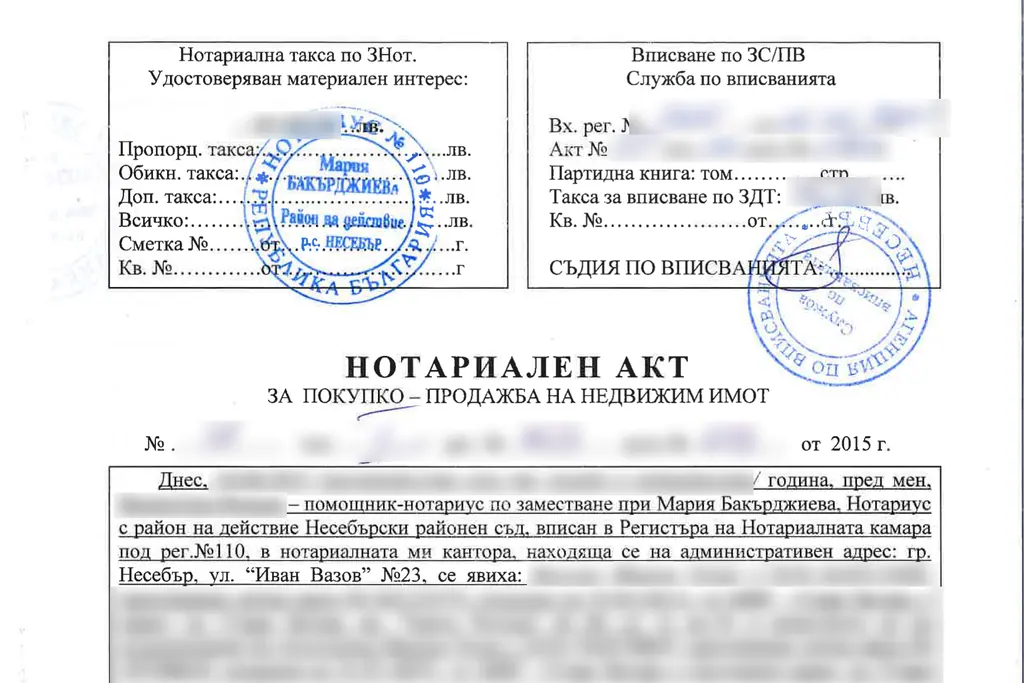 Buying
10 November 2026 · 6 min read
After the notary: what happens once the deed is signed, and who does it
Registration, BULSTAT, the municipality, electricity and water. What has to happen after the notarial deed is signed, and why the buyer should not be the one running between offices.
 Buying
28 October 2026 · 5 min read
Buying an apartment in Bulgaria: the route from reservation to keys
Reservation, legal checks, the day at the notary and the registrations afterwards. What happens at each step and who does what.
 Buying
21 October 2026 · 4 min read
Buying without travelling, or with a single trip
Two ways foreign clients buy on the coast: fully remotely through a power of attorney, or by flying in for the notary day only.
Talk to a lawyer.
Tell us briefly what you need. Daniela or a member of the team will reply as soon as possible.
Private & confidential
Tell us about your case.
Start your case
Ready when you are.
- Daniela Collins
- +359 877 830 689d.collins@collins-solicitors.com
- Dimitar Nikolov
- +359 878 492 317d.nikolov@collins-solicitors.com
- Office
- Business Center “Sapphire”8240 Sunny Beach, BulgariaOpen in Google Maps ↗Parking for clients ↗