Buying · 6 min read
After the notary: what happens once the deed is signed, and who does it
Registration, BULSTAT, the municipality, electricity and water. What has to happen after the notarial deed is signed, and why the buyer should not be the one running between offices.
10 November 2026Collins Solicitors legal team
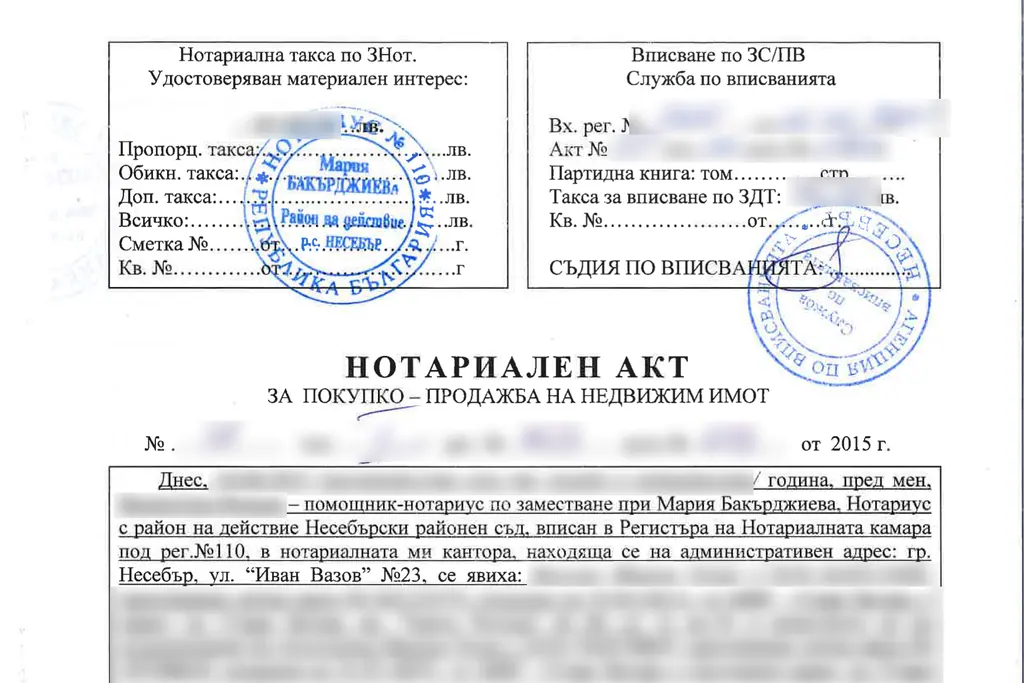
Signing at the notary is the moment everyone remembers. The buyer becomes the owner, the keys change hands, and it feels as if the work is done. Legally, a few more things still have to happen in the following days and weeks. None of them is difficult, but each takes place in a different office, under its own rules and in Bulgarian. Done properly, this is the lawyer’s job, not the buyer’s.
In our practice the client signs one notarised power of attorney, usually on the day of the deal, and leaves everything below to our office. Here is what we do and why.
1. The deed is entered in the Property Register
After signing, the notary sends the deed for entry in the Property Register kept by the Registry Agency. The entry is what makes your ownership effective against third parties. We collect the entered deed, check that the entry shows the right apartment, the right owner and the right share of the common parts, and give you a copy with a translation.
2. Registration in BULSTAT
A foreign owner who has no Bulgarian personal number (ЕГН or ЛНЧ) must be entered in the BULSTAT register as the owner of real estate in Bulgaria (Art. 3(1)(10)(b) of the BULSTAT Register Act). The application is due within seven days of the purchase (Art. 12). The law allows a lawyer with an express power of attorney to file it (Art. 9(3)), so we do it and hand you your BULSTAT number. The municipality and the utility companies use it to identify you.
3. The municipality: property tax and waste fee
Many buyers expect to have to declare the apartment to the municipality. Since 2019 that is not required after a purchase: no annual tax declaration is filed for property acquired by sale or gift, because the municipality receives the data through the transfer itself (Art. 14(3) of the Local Taxes and Fees Act). For a newly built building, the developer supplies the data on the new apartments (Art. 14(2)).
What remains is to make sure the system has actually done its part. We check that the local revenue office has opened a tax account for the apartment in your name with the correct data, obtain the amounts of the property tax and the waste fee, and give you the payment details. The tax for the months up to and including the month of the sale is paid by the seller. After that the usual deadlines apply, 30 June and 31 October, with a 5% discount for paying the whole year by 30 April; if you bought after a deadline has passed, that part is paid within two months of the purchase (Art. 28). The amounts in Nessebar municipality are covered in our article on property taxes.
4. Electricity and water accounts
This step is often misunderstood. The accounts with the electricity supplier (EVN in this region) and with the local water company have nothing to do with ownership. They are supply contracts held in the name of whoever is registered as the customer. The Property Register does not update them, and changing them neither proves nor affects your title.
They still need to be transferred: so that bills arrive in your name, so that the meter readings on the day of handover are recorded, and so that any debt of the previous holder stays with them. We file the transfer with both companies using the deed and the meter readings. In a new building the accounts pass from the developer to you.
5. The maintenance contract
In a gated complex, management of the common parts is governed by a contract between the investor and each owner, signed with notarised signatures and entered against the apartment. We make sure it is signed and registered and that you have a copy. The manager then simply does its job under that contract; it needs no power of attorney from you. What such a contract contains is explained in our article on the maintenance fee.
What you receive at the end
- the entered notarial deed, with a translation;
- your BULSTAT number, where one is required;
- confirmation of the municipal tax account, the amounts due and how to pay them;
- the customer numbers for electricity and water in your name;
- a copy of the registered maintenance contract;
- a short list of the yearly deadlines.
What remains your choice
Some things are not part of the transaction and are decided by the owner. Home insurance is not required by law for an apartment; a bank will ask for it only if there is a mortgage. If you want someone to represent you later, for example to rent the apartment out or to deal with repairs while you are abroad, that is a separate power of attorney for a separate task. We are happy to arrange either, but neither is a condition of owning the apartment.
A well-run purchase ends with the buyer having nothing left to chase. If you have already bought and are not sure whether all of the above was done, send us your deed and we will check.
Legal basis and sources
- BULSTAT Register Act, Art. 3(1)(10)(b), 9(3) and 12 ↗
- Local Taxes and Fees Act (ЗМДТ), Art. 14(2)–(3) and 28 ↗
- Registry Agency: Property Register ↗
This article is general information, not legal advice for your situation. Laws and local rates change; ask us before you act.
Read next
All articles Buying
28 October 2026 · 5 min read
Buying an apartment in Bulgaria: the route from reservation to keys
Reservation, legal checks, the day at the notary and the registrations afterwards. What happens at each step and who does what.
 Buying
21 October 2026 · 4 min read
Buying without travelling, or with a single trip
Two ways foreign clients buy on the coast: fully remotely through a power of attorney, or by flying in for the notary day only.
 Buying
14 October 2026 · 5 min read
Six checks before you pay a deposit, and where the money should go
What a lawyer verifies before a property purchase in Bulgaria, what a reservation agreement should say, and why the deposit never goes straight to the seller.
Talk to a lawyer.
Tell us briefly what you need. Daniela or a member of the team will reply as soon as possible.
Private & confidential
Tell us about your case.
Start your case
Ready when you are.
- Daniela Collins
- +359 877 830 689d.collins@collins-solicitors.com
- Dimitar Nikolov
- +359 878 492 317d.nikolov@collins-solicitors.com
- Office
- Business Center “Sapphire”8240 Sunny Beach, BulgariaOpen in Google Maps ↗Parking for clients ↗